
Stories

Michael Boyce: Investigating the Role of Sugar-Coated Proteins in Cell Signaling
Michael Boyce’s scientific journey began where the human cell’s life cycle ends. Cell death captivated him from the start of his graduate work. “The idea that there are genetic programs that cells use to die upon the right stimulus or the right timing was a really interesting concept,” he says.
How cells die has huge implications for health, Boyce says. “For example, cancer is, in part, a failure of cells to kill themselves at the right time. Another example is that the immune system can instruct cells to kill themselves when they are infected with a virus.”
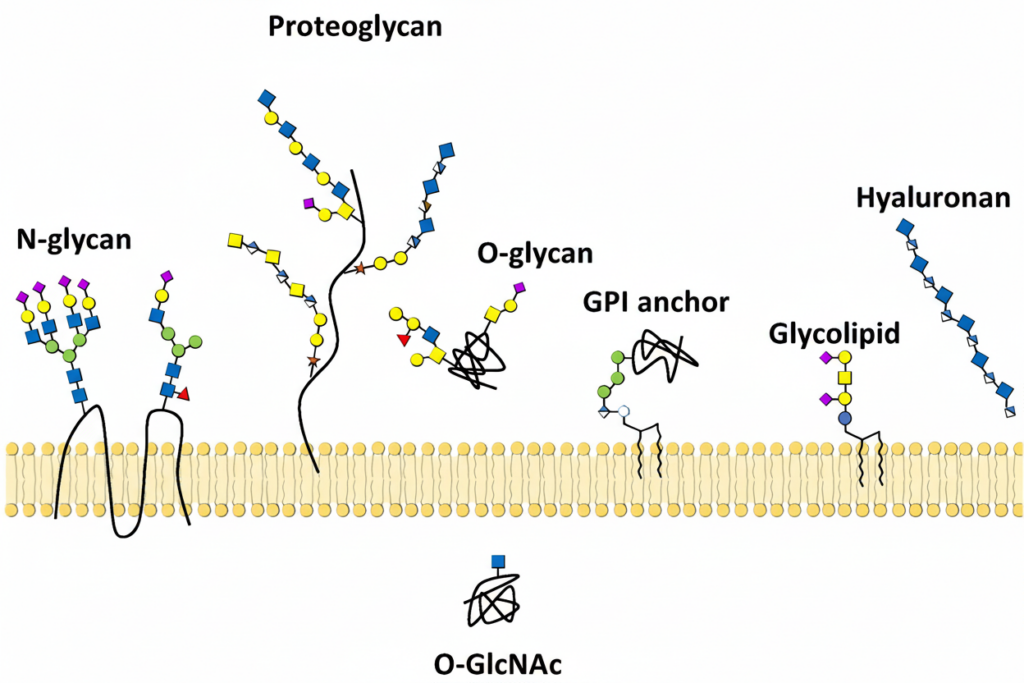
This fascination with cell death would eventually lead Boyce to discover a new interest in an important process called glycosylation that affects protein production in mammals and other organisms. During this process, sugar molecules are added onto proteins during their maturation. “Glycosylation is fundamental to just about every cell biological process and not that well understood compared to some other areas of biology,” he says.
During his graduate work at Harvard University, Boyce first focused on the stress signal in a cell compartment called the endoplasmic reticulum, which is responsible for synthesizing proteins and exporting them out of the cell. These proteins require glycosylation in order to fold and function properly. The sugar molecules also act as markers that help other molecules recognize the proteins. When glycosylation is disrupted and proteins misfold, a stress response occurs in the endoplasmic reticulum, sometimes leading to cell death. Boyce and his colleagues in the lab of Junying Yuan identified a small molecule called salubrinal that protects cells from dying due to this stress response. This discovery led to a better understanding of how the endoplasmic reticulum stress signal can be switched on and off.
Sensing this was an area of science where there was still a lot of room for a young scientist to contribute, Boyce continued working on glycosylation as a postdoc at the University of California, Berkeley with Carolyn Bertozzi, who specializes in the chemistry of glycobiology. He began investigating a special type of glycosylation known as O-linked N-acetylglucosamine, or O-GlcNAc. While most glycosylation takes place on proteins that are outside of a cell, O-GlcNAc happens within the cell and controls a wide range of cellular processes. It has also been linked to diseases such as neurodegeneration, diabetes, and cancer.
With the help of Bertozzi’s expertise in chemistry, Boyce studied different aspects of glycoproteins through chemical approaches that he had not previously studied. Building on this research, he developed novel tools to study O-GlcNAc signaling.
In 2012, Boyce joined Duke University as a newly minted assistant professor in the School of Medicine and built a lab specializing in understanding the role of glycosylation in mammalian cells using various chemical tools. “What we do is basic biology,” he says. “It’s not translational, not clinical, but biology that is still relevant to human health and diseases.”
Boyce emphasizes the importance of funding, training, and support for his research achievements. “I’ve been fortunate to have good mentors at all career stages,” he says. Grants such as the Rita Allen Foundation Scholars Award, which he received in 2013, have allowed him to explore interesting topics in science and secure future funding.
“The funding model is so helpful and impactful for individual investigators. When you’re a new faculty member, they don’t expect you to have a decade’s worth of new discoveries in your independent lab,” Boyce says. “That’s even more important at a time when support from the government and other agencies is uncertain or shrinking.”
Since receiving the award, one part of the Boyce Lab has focused on understanding O-GlcNAc. “One thing that has emerged as a theme among several of our projects and papers is that O-GlcNAc can regulate interactions between proteins at the biochemical or biophysical level. And you can also see the downstream effects that those interactions have on the whole organism,” he says. “So, I’m excited about that.”
Recently, Boyce’s team discovered that an enzyme responsible for regulating sugar metabolites is also crucial for making mucus. “Not everyone finds mucus to be a sexy topic, but mucus is on every epithelial organ surface in the body: It coats the airway; it coats the gut and the intestines; it’s critical for providing a protective barrier against microbes or toxicants or particles,” he says. The properties of mucus, which rely heavily on the proper glycosylation of proteins called mucins, are important in health and disease.
Boyce is proud of what his lab was able to accomplish early on and excited about the possibilities ahead. On the wall in his office hangs a picture of Duke Chapel when it was still under construction, about 90 years ago. “I actually bought this when I was a new junior faculty member,” he says, “It’s a metaphor: that we’re building good things at Duke.”
Boyce recently shared his thoughts on diversity and mentorship and advice for early-career scientists.
Apart from the research, what aspects of being a professor do you enjoy?
I get a lot of satisfaction, on a personal level, from mentoring and helping to train the next generation of scientists. I am also very active in the equity, inclusion, and diversity space in science. It is extremely important for biomedical research and the biomedical workforce to include as many people in our country as possible. We want all the best brains.
What advice can you offer for early-career scientists starting their own independent research labs?
Don’t be boring. I think rigorous but also bold, innovative ideas are the way to go. For example, in faculty search committees, we want to see people’s big-picture vision, their exciting ideas, their blue-sky thoughts. But you have to couple that with practicality: Get experiments done, mentor people in your lab, and raise money to get that stuff done.