
Stories

Rebecca Seal: Uncovering How Pain Signals Travel Through the Nervous System
Rebecca Seal was majoring in chemistry and psychology at the University of Oregon and planning to go to medical school when she spent a summer working in a neuroscience lab at the Vollum Institute at Oregon Health & Science University. At the time, she saw herself one day treating patients.
But she also had a fascination with the biology underlying neurological diseases, understanding the causes, and figuring out how to cure them. “As soon as I stepped into the lab, I knew this is exactly what I wanted to do with my life,” Seal says.
Her time in the lab that summer led her to pursue a Ph.D. in neuroscience. The prospect of tackling fundamental questions for which no one has an answer was exhilarating. “It’s something that still surprises and captivates me: what is unknown and what exists and connecting the not-very-obvious dots,” she says. This pathway into research would launch her journey to discover some of the fundamental workings of the nervous system, primarily in sensory systems, vision, olfaction, auditory and most intensely somatosensation, particularly chronic pain.
Seal began her graduate work at the Vollum Institute in Susan Amara’s lab studying the structure and function of amino acid transporters. As their name suggests, these proteins carry amino acids into and out of the cell, helping to regulate levels of neurotransmitters, the chemical messengers that transmit signals between neurons.
Seal’s research focused on glutamate transporters, which are critical for regulating the major excitatory neurotransmitter and have thus been linked to many nervous system disorders, including schizophrenia, stroke, ALS and epilepsy. She examined substrate and inhibitor binding sites on the transporters, which act as gatekeepers for the movement of glutamate and transport chloride like an ion channel, and showed that the transporters carry out these two functions independently of each other. This suggests that each can be controlled separately without affecting the other. This kind of selective control could be useful for developing therapies to address specific neural pathways.
After completing her Ph.D., Seal joined the lab of Robert Edwards at the University of California, San Francisco, where she studied a protein that packages glutamate into synaptic vesicles for its regulated release, the vesicular glutamate transporter 3 (VGLUT3). Studying this transporter in mice, she found that it had unexpected roles in several sensory systems including hearing and in mechanical pain. Seal generated mice that lacked the VGLUT3 gene and performed experiments, including one that revealed the mice were profoundly deaf. Looking into the cause of the deafness, Seal and colleagues discovered that the transporter packages glutamate into vesicles in cochlear inner hair cells.
“In cases where glutamate cannot be released from synaptic vesicles of inner hair cells, which are the cells that respond to sound, you have profound deafness,” she says. Given the otherwise intact cochlea, “I thought this model was well-suited for testing whether we could restore hearing in these deaf mice by delivering the gene for the transporter to the inner hair cells.”
By injecting a viral vector containing the VGLUT3 gene into the cochlea of the knockout mice, Seal and her colleagues were able to restore their hearing. It was the first demonstration of a successful gene therapy for deafness. “It was uncertain whether this would work for many reasons, but the result was just what I had hoped,” she says. “It was amazing!”
The same strategy was then applied by her collaborators to a gene for another inner hair cell vesicle protein that produces deafness when absent in mice and humans. The therapy is now showing success in phase II clinical trials to treat kids with this form of genetic deafness. Seal added that she is a big believer in the potential of gene therapies and is currently working on one for pain.
In 2010, Seal established her independent lab in the Department of Neurobiology at the University of Pittsburgh and continued studying the role of VGLUT3 in diseases. She was particularly interested in pursuing the mechanical pain phenotype of VGLUT3, which she had previously found was critical for mechanical allodynia, a condition in which touch becomes painful following nerve injury or tissue damage.
In her own laboratory, she showed that a particular subtype of neurons in the spinal cord that relies on VGLUT3 underlies its critical role in mechanical allodynia. At the time, researchers knew this type of pain involves changes in the neural circuits of the spinal cord, but not much was known about which neurons made up those circuits.
In 2013, Seal received the Rita Allen Foundation Scholars Award in Pain, which enabled her to explore this new research direction. “Not only do they provide Scholars with funds for launching research projects, but they continue to be supportive in other ways throughout your career,” she says. Seal is particularly appreciative of the community support she receives from the Foundation and fellow Pain Scholars, such as during the pandemic when they held regular virtual meetings to discuss each other’s work.
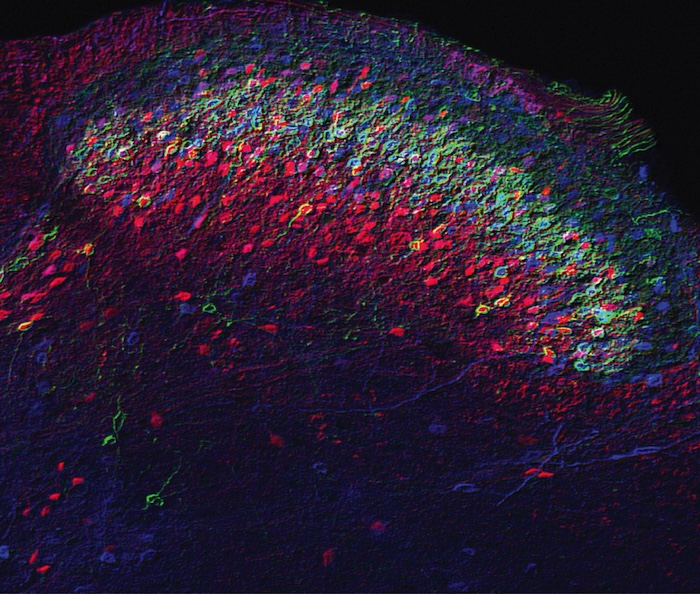
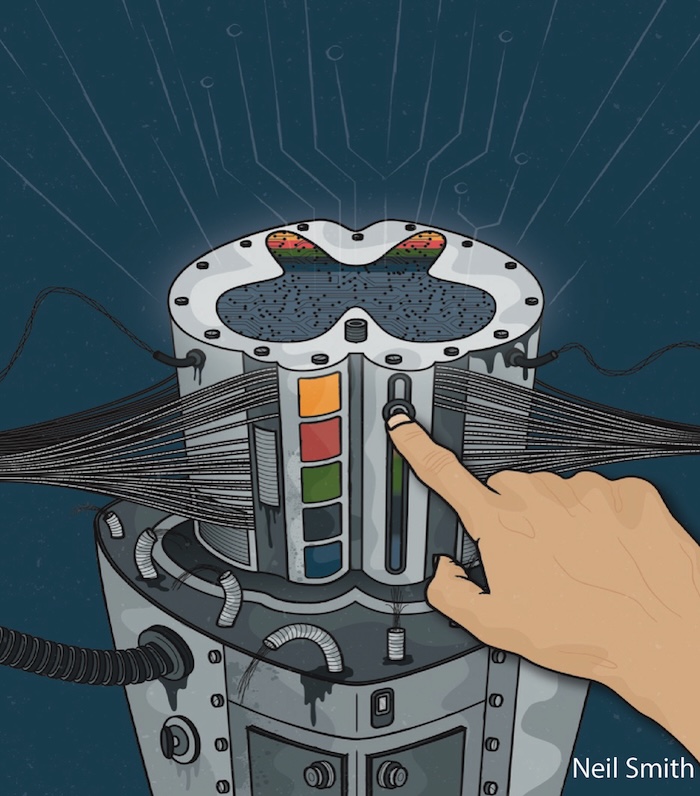
Soon after receiving the Scholars Award, Seal and Cedric Peirs, a postdoc in her lab, identified specific neuron populations within the dorsal horn of the spinal cord that have an important role in mechanical allodynia. Under normal circumstances, the primary sensory neurons and dorsal horn interneurons that convey touch are prevented from activating neurons in the dorsal horn that signal pain. However, after an injury, in some cases, those touch circuits gain access to the neuron populations that signal pain. In the short-term, this mechanism of generating pain from touch acts as a cue to avoid further injury to the area. In the long-term, the pain can become chronic and disabling.
In addition to identifying components of the circuitry, Peirs, Seal and colleagues discovered that different spinal circuitry is involved depending on the nature of the injury. The mechanical allodynia pathway for arthritis, for example, overlaps with, but also differs from, the mechanical allodynia pathway recruited by a nerve trauma. “We didn’t expect to find differences in the circuitry depending on the type of injury in the dorsal horn,” Seal says. The work, which was published in 2021 in the journal Neuron, has important implications for how mechanical allodynia should be therapeutically targeted in the dorsal horn, taking into account the type of injury.
Since then, Seal and her team have continued to investigate the dorsal horn mechanical allodynia circuitry for polyneuropathic injuries, such as diabetes and chemotherapeutic neuropathy and expanding to other forms of pain, such as spontaneous pain, which occurs without an obvious external cause. “Most forms of persistent pain signal through the spinal cord,” she says, making it an attractive region of the nervous system for targeting therapeutically.
Their recent work includes the use of genomic techniques to understand how genetic variations in chronic pain patients map to dorsal horn cell types. “We’re continuing to work on generating an integrated atlas of the cell types in the dorsal horn across species,” Seal says. “And we’re finding enhancers that we can use to regulate the activity of key cell types in both rodents and primates.” The hope is these can one day be used to turn off unnecessary pain permanently in those who are suffering.
Seal recently shared more about her career and how the Rita Allen Foundation continues to be a part of it.
Apart from the research, what aspects of being an academic scientist do you enjoy?
I have been very involved with the US Association for the Study of Pain. I worked with Michael Gold and Jennifer Haythornthwaite and others on the relaunch, and then served on the Board of Directors, and on the Sponsorship and Awards Committees.
I have also become very involved with the International Association for the Study of Pain. I was invited to be on the Editorial Board of the Pain Research Forum (PRF) when it was run by Neil Andrews and Ted Price. During that time, in 2019 or so, I had the idea for a podcast that would feature casual conversations among pain scientists about issues of interest in the field. We named it The Pain Beat. Now there are many podcasts, but at the time it somewhat unusual. The Rita Allen Foundation has sponsored the podcast.
Currently, I am honored to run the Pain Research Forum, together with a committee of early career contributors and PRF Editorial Board members. PRF is a gem that fields don’t typically have. Several Rita Allen Pain Scholars are also on the PRF Editorial Board.
How has your research been impacted by the Rita Allen Foundation Scholars Award?
The Rita Allen Award funded our initial work on the dorsal horn circuitry that led to NIH funding and to publishing our work in this area. It was instrumental in getting the data we needed to submit a strong grant. I think that what’s so terrific about the Rita Allen Foundation is the continued involvement of the Foundation with the Rita Allen Pain Scholars, sponsoring events, involving them in the grant review process and continuing to highlight, promote and share their discoveries.